![Servecorp Corporate Services (M) Sdn Bhd [202301020747 (1514669-X)]](https://www.servecorp.com.my/image/catalog/servecorp_logo.png "Servecorp Corporate Services (M) Sdn Bhd [202301020747 (1514669-X)]")
![Servecorp Corporate Services (M) Sdn Bhd [202301020747 (1514669-X)]](https://www.servecorp.com.my/image/catalog/servecorp_logo_mobile.jpg "Servecorp Corporate Services (M) Sdn Bhd [202301020747 (1514669-X)]")
How to Set Up an F&B Company in Malaysia: A Compliance Guide for Local and Foreign Investors
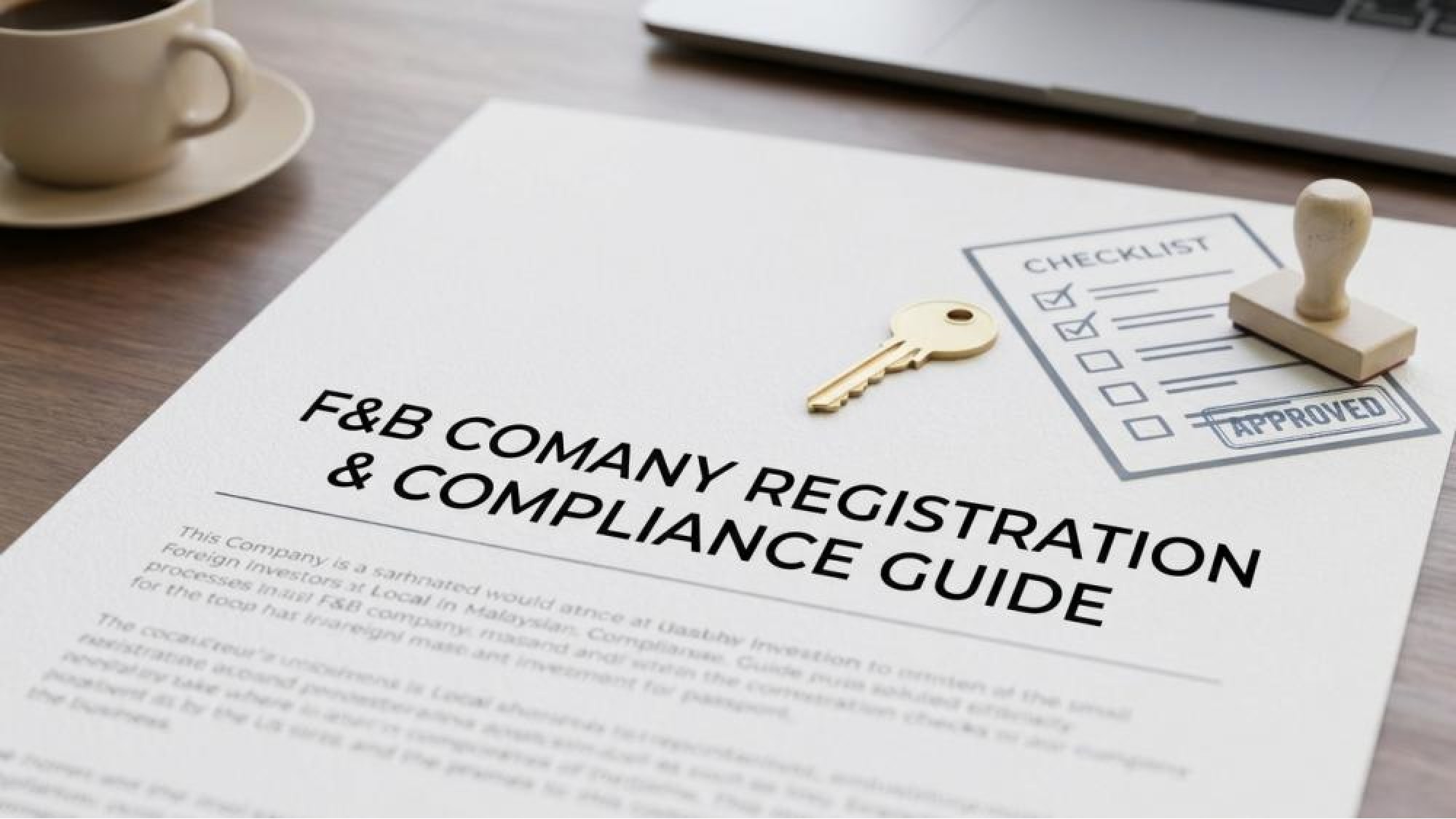
Penang is widely recognized as one of Malaysia’s leading food and tourism destinations. Its diverse Malay, Chinese, Indian, Peranakan and international influences have created a vibrant market for restaurants, cafés, bakeries, food kiosks, catering businesses and new food concepts.
A successful F&B business, however, requires more than a great menu and attractive location. It must begin with the right business structure, sufficient capital, proper tax registration and the necessary operating licenses.
Here is a practical compliance guide for local entrepreneurs and foreign investors planning to establish an F&B company in Malaysia.
1. Register the Business with SSM
Local entrepreneurs may operate through a sole proprietorship, partnership, limited liability partnership or private limited company.
A Sdn. Bhd. is commonly preferred where the owners intend to:
- Expand to multiple outlets;
- Introduce investors or business partners;
- Build a franchise or recognised brand;
- Separate personal and business liabilities; or
- Establish a foreign-owned F&B business.
A Malaysian private company must have one or more members, one or more shares and at least one director. At least one director must ordinarily reside in Malaysia by having a principal place of residence in the country. A qualified company secretary must be appointed within 30 days after incorporation.
Company incorporation can be completed online through SSM’s MyCoID portal. The official SSM guidance and portal can be accessed through the SSM company-incorporation page.
Registering a company with SSM does not automatically authorise the company to operate a restaurant or café. Separate premises, food-safety and local-council licenses are normally required.
2. Determine the Appropriate Paid-Up Capital
The Companies Act 2016 does not impose a universal RM1 million minimum paid-up capital for every Malaysian private company.
For a locally owned small F&B business, the initial paid-up capital should be commercially reasonable and sufficient to support matters such as:
- Rental deposits;
- Renovation;
- Kitchen equipment;
- Furniture and fittings;
- Initial inventory;
- Employee costs;
- Licensing expenses; and
- Working capital.
Starting with a nominal capital amount may be legally possible at incorporation, but it may not be commercially suitable for a restaurant that needs to secure premises, apply for licenses, open a bank account or demonstrate its ability to operate.
Foreign-owned F&B companies require additional consideration.
Under Ministry of Domestic Trade and Cost of Living Malaysia (KPDN) guidelines on foreign participation in distributive-trade services, certain foreign-owned distributive-trade businesses are expected to maintain minimum shareholders’ funds of RM1 million, which include paid-up capital and reserves. However, the classification and requirement depend on the actual F&B concept and KPDN’s assessment.
Foreign investors should confirm the applicable capital requirement before:
- Incorporating the company;
- Transferring the full investment capital;
- Signing a tenancy agreement;
- Applying for expatriate positions; or
- Commencing renovation.
3. Review WRT Approval for Foreign Investors
Foreign participation in restaurants and other F&B activities may fall within Malaysia’s distributive-trade framework.
The approval is commonly referred to in practice as a WRT approval or WRT license, although the formal process concerns approval for foreign participation in distributive trade.
Depending on the business model, KPDN may review:
- The percentage of foreign ownership;
- The nature and concept of the restaurant;
- Shareholders’ funds and paid-up capital;
- The proposed premises;
- Business plans and financial projections;
- Employment opportunities;
- Appointment of local employees;
- Value brought to the Malaysian market; and
- Compliance with other operating licenses.
The RM1 million shareholders’ funds requirement should not be represented as an automatic rule for every local restaurant or every form of F&B activity. Its application depends on the foreign-owned business category and the prevailing KPDN requirements.
Foreign investors should therefore obtain professional guidance before finalizing the ownership structure and capital contribution.
Official guidelines and application documents for foreign participation in distributive trade are available from the Ministry of Domestic Trade and Cost of Living, KPDN.
4. Confirm LHDN and e-Invoice Compliance
After incorporation, the company should confirm its Tax Identification Number and tax profile through LHDN’s MyTax portal.
An F&B company may need to comply with:
- Corporate income tax;
- CP204 estimated tax instalments;
- Annual tax-return submission;
- Employer tax registration;
- Monthly Tax Deductions for employees;
- Withholding tax on certain payments to non-residents;
- e-Invoice requirements; and
- Transfer pricing rules for related-party transactions.
Foreign-owned businesses should pay attention to payments made to overseas shareholders or related companies, including:
- Franchise fees;
- Royalties;
- Management fees;
- Interest;
- Technical-support fees;
- Marketing charges; and
- Purchases from related suppliers.
These transactions should have genuine commercial purposes and be supported by agreements, invoices, transfer pricing analysis and appropriate tax treatment.
5. Review SST Registration
F&B operators should determine whether they are required to register for Service Tax.
The Royal Malaysian Customs Department states that food and beverage services are subject to 6% Service Tax when supplied by a taxable person who is liable to be registered.
Customs’ business FAQ states that food and beverage services provided by a restaurant operator become subject to Service Tax when the operator’s annual taxable turnover exceeds RM1 million.
The threshold should be monitored using the applicable historical and future methods over a 12-month period. Service Tax registration is completed online through the MySST system.
A registered F&B operator must generally:
- Charge the applicable Service Tax;
- Issue compliant invoices;
- Submit SST-02 returns;
- Pay the tax within the prescribed period;
- Maintain proper records; and
- Continue filing returns even where no tax is payable for a taxable period.
The SST treatment may differ for restaurants, cafés, food courts, caterers, central kitchens, food manufacturers and businesses supplying both goods and services. A specific review should therefore be conducted based on the operating model.
6. Obtain Local Authority and Food-Premises Approvals
Before signing a tenancy agreement, the operator should confirm that the premises may legally be used for the proposed F&B activity.
Depending on the location and local council, the business may require:
- Food-establishment or business-premises license;
- Signboard license;
- Planning or change-of-use approval;
- Renovation or building-plan approval;
- Outdoor dining approval;
- Grease-trap and drainage compliance; and
- Waste-disposal arrangements.
MalaysiaBiz helps business owners identify licenses, registrations, permits and approvals according to their business activities and location.
Penang businesses should also check the requirements of the relevant local authority, such as the Penang Island City Council or Seberang Perai City Council.
7. Comply with Food-Safety Requirements
F&B operators must comply with Malaysia’s food-safety and hygiene framework.
The Ministry of Health explains that the Food Hygiene Regulations 2009 regulate food premises, owners and food handlers in relation to food preparation, handling, storage, packaging and transportation.
Depending on the operation, the business should address:
- Registration of the food premises;
- Food-handler training;
- Typhoid vaccination requirements;
- Cleanliness and pest control;
- Safe food storage and preparation;
- Appropriate kitchen layout;
- Employee hygiene; and
- Proper handling of imported or packaged food.
Food-premises and food-safety matters can be managed through the Ministry of Health’s FoSIM system.
8. Review BOMBA and Other Special Approvals
A restaurant or café may also need to comply with BOMBA fire-safety requirements, particularly where renovation changes the premises layout, kitchen exhaust system, emergency exits or fire-protection facilities.
Depending on the business concept, additional approvals may relate to:
- Halal certification;
- Imported food and Customs permits;
- Liquor licensing;
- Entertainment or music;
- Outdoor seating;
- Franchising;
- Food manufacturing;
- Product labelling; or
- Central-kitchen operations.
The exact licenses depend on the menu, premises, local authority, foreign ownership and operating model.
Set Up Your F&B Business with Servecorp Group
Establishing an F&B business requires coordination across company law, taxation, SST, foreign-investment requirements and local operating licenses.
Servecorp Group provides one-stop support for local entrepreneurs and foreign investors, including:
- Malaysian company incorporation;
- Foreign-owned company setup;
- Company secretarial services;
- Shareholding and paid-up capital planning;
- Accounting and financial reporting;
- Corporate tax compliance;
- SST advisory and registration;
- Payroll and employer compliance;
- Transfer pricing advisory and documentation;and
- Ongoing corporate advisory services.
Ready to Start Your F&B Business in Malaysia?
A strong food brand should be built on a strong business foundation.
Contact Servecorp Group today and let our team guide you from company incorporation and capital planning to accounting, taxation, SST, transfer pricing and regulatory compliance.
Servecorp Group
Beyond Compliance, Enpowering Business Success
Your Trusted Corporate Advisory Partner in Penang, Malaysia
Turn your F&B idea into a properly structured and sustainable Malaysian business.